


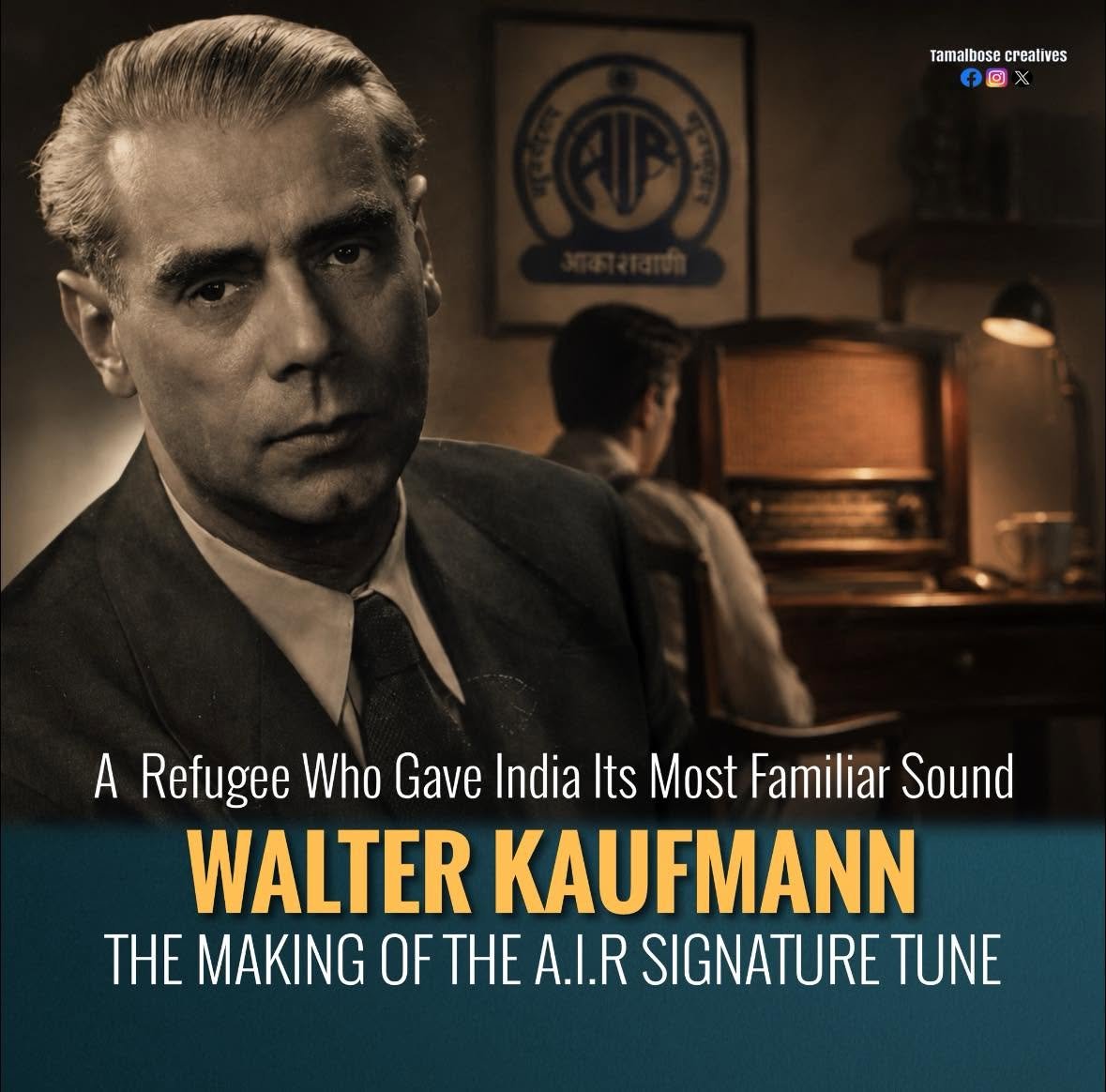
For millions of Indians, the familiar strains of the Akashvani signature tune evoke a sense of home, continuity, and shared memory. Yet the man who composed it had once been forced to leave his own home behind. Fleeing the growing threat of Nazi persecution in Europe, a Jewish refugee found shelter in India and went on to create one of the most recognisable sounds in the nation’s broadcasting history.
That refugee was Walter Kaufmann, a Czech-born composer who arrived in India in 1934 in search of safety. As Nazi Germany rose to power across Europe in the 1930s, life became increasingly dangerous for Jewish communities. India offered Kaufmann not only refuge, but also the opportunity to begin a new chapter of his life.
Kaufmann quickly established himself within India’s musical circles. His mastery of Western classical music, combined with a deep fascination for Indian musical traditions, earned him recognition among musicians and scholars alike. He immersed himself in the study of Indian ragas, folk music, and traditional instruments, seeking to build a bridge between two distinct musical worlds.
It was this reputation that led to his appointment as Director of Music at All India Radio, Bombay, in 1937. At the time, AIR was looking for a distinctive signature tune, something that listeners would instantly associate with the beginning of a broadcast.
The task was entrusted to Walter Kaufmann.
Drawing inspiration from the tonal structure of Raga Shivaranjani, he composed a short yet evocative melody. Blending Indian musical ideas with Western orchestral sensibilities, Kaufmann created a tune unlike any other. The violin part was performed by Mehli Mehta, father of the future world-renowned conductor Zubin Mehta.
Those few seconds of music would eventually become the sonic identity of Akashvani. For decades, generations of Indians heard it before news bulletins, cultural programmes, and radio broadcasts. Composed before India’s independence, the tune remains one of the most recognisable sounds in the country’s broadcasting history.
Kaufmann left India in 1946 and later continued his career in Canada and the United States as a composer, scholar, and teacher. Yet his most enduring legacy remained in the country that had once given him refuge.
History often unfolds in unexpected ways. A man who lost his homeland in Europe went on to create a melody that became part of another nation’s memory.
Sometimes, becoming part of a country’s cultural heritage has little to do with where one is born. It is shaped instead by talent, opportunity, and the humanity of those willing to offer shelter
Source ; Tamal Bose in Facebook